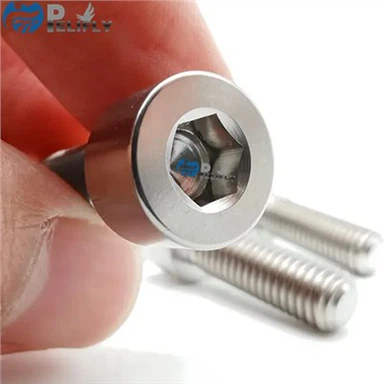

Bolts vs. Screws: Understanding the Differences and Terminology for Proper Fastener Selection
May 21, 2023
Differentiation between titanium Bolts and Screws:
Function and Purpose:
Bolt: A bolt is primarily used to join two or more unthreaded components together. It typically requires a nut to secure the joint.
Screw: A screw is designed to be self-tapping and creates its own internal threads in the material it is being fastened into. It can be used to join two or more components directly.
Thread Type:
Bolt: Bolts have a partially threaded shank, typically with a smooth, unthreaded portion near the head. The threaded section allows for engagement with a nut.
Screw: Screws have a fully threaded shank from the head to the tip, allowing them to create threads in the material being fastened.
Head Design:
Bolt: Bolts usually have a larger, hexagonal head or a square head, which allows for a wrench or socket-driven tightening.
Screw: Screws commonly have a smaller, slotted, Phillips, or Torx head, designed for driving with a screwdriver or specific screwdriver bits.
Fastening Application:
Bolt: Bolts are commonly used in applications where disassembly and reassembly may be required, or where a stronger joint is needed.
Screw: Screws are typically used in applications where a secure, permanent fastening is desired, such as attaching hinges, brackets, or fastening materials to walls or other surfaces.
Terminology Associated with Bolts and Screws:
Shank: The unthreaded portion of a bolt or the threaded portion of a screw between the head and the tip.
Thread Pitch: The distance between adjacent threads on a bolt or screw, measured in threads per inch (TPI) or millimeters (mm).
Diameter: The measurement of the major diameter of the threads on a bolt or screw.
Head Type: The specific design of the head, such as hexagonal (hex head), square head, slotted, Phillips, Torx, etc.
Nut: A fastener with an internally threaded hole that mates with a bolt, providing the clamping force when tightened.
Drive Type: The type of tool or driver required to turn or tighten the bolt or screw, such as a wrench, socket, screwdriver, or specific bits.
Thread Engagement: The depth to which the threads of a bolt or screw engage with the material being fastened.
Understanding these differences and terminology can help in correctly identifying and selecting the appropriate fastener for specific applications.