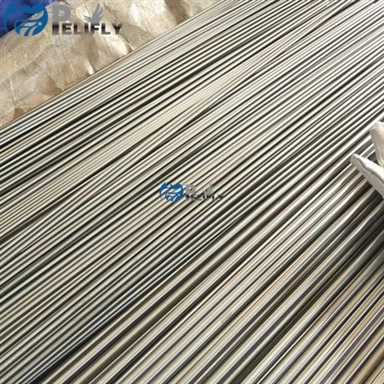

Titanium Pipes: Balancing Lightness and Durability
Jan 01, 2024
Titanium pipes, as a lightweight, high-strength, and corrosion-resistant metal material, have found widespread applications in various fields. In this discussion on the relationship between the weight and durability of titanium pipes, the manufacturer takes you through several aspects.
Firstly, the lightweight nature of titanium pipes is determined by their properties. Titanium has a density of about 4.5 grams/cubic centimeter, while steel has a density of approximately 7.8 grams/cubic centimeter. Therefore, when comparing titanium pipes to steel pipes of the same volume, titanium pipes are significantly lighter. This makes titanium pipes an ideal choice in fields with high weight requirements, such as aerospace, maritime, and automotive manufacturing. It contributes to reducing the overall structure's weight, enhancing payload capacity, and saving fuel consumption.
Secondly, the excellent corrosion resistance of titanium pipes is a key factor in their durability. Titanium exhibits remarkable corrosion resistance against oxidation, acids, alkalis, and seawater. Titanium pipes used in marine environments outperform other materials, effectively resisting corrosion and oxidation in seawater. Additionally, titanium pipes demonstrate corrosion resistance in atmospheric conditions, thanks to the naturally occurring dense oxide film on the titanium surface, effectively preventing further oxidation and corrosion. Therefore, in fields with high corrosion resistance requirements, such as chemical engineering and marine exploration, titanium pipes have a longer lifespan and better durability.
Furthermore, the high strength of titanium pipes guarantees their durability. With higher yield strength and tensile strength, titanium pipes can withstand significant external forces and impact loads. This ensures that titanium pipes maintain structural integrity and stability, resisting deformation or breakage even in challenging environments. Especially in conditions with high temperature, pressure, and vibrations, titanium pipes can preserve their original performance without significant loss. As a result, titanium pipes have broad prospects for applications in aerospace, shipbuilding, petrochemicals, and more.
However, the relatively high cost of titanium pipes limits their widespread use. The complex extraction and processing processes contribute to higher production costs compared to common metals. Therefore, in cost-sensitive fields such as construction and home furnishings, titanium pipes are often used only in specific scenarios with special requirements. Additionally, the processing and welding techniques for titanium pipes are relatively challenging, requiring high technical expertise and equipment support, adding to the difficulty and cost of using titanium pipes.